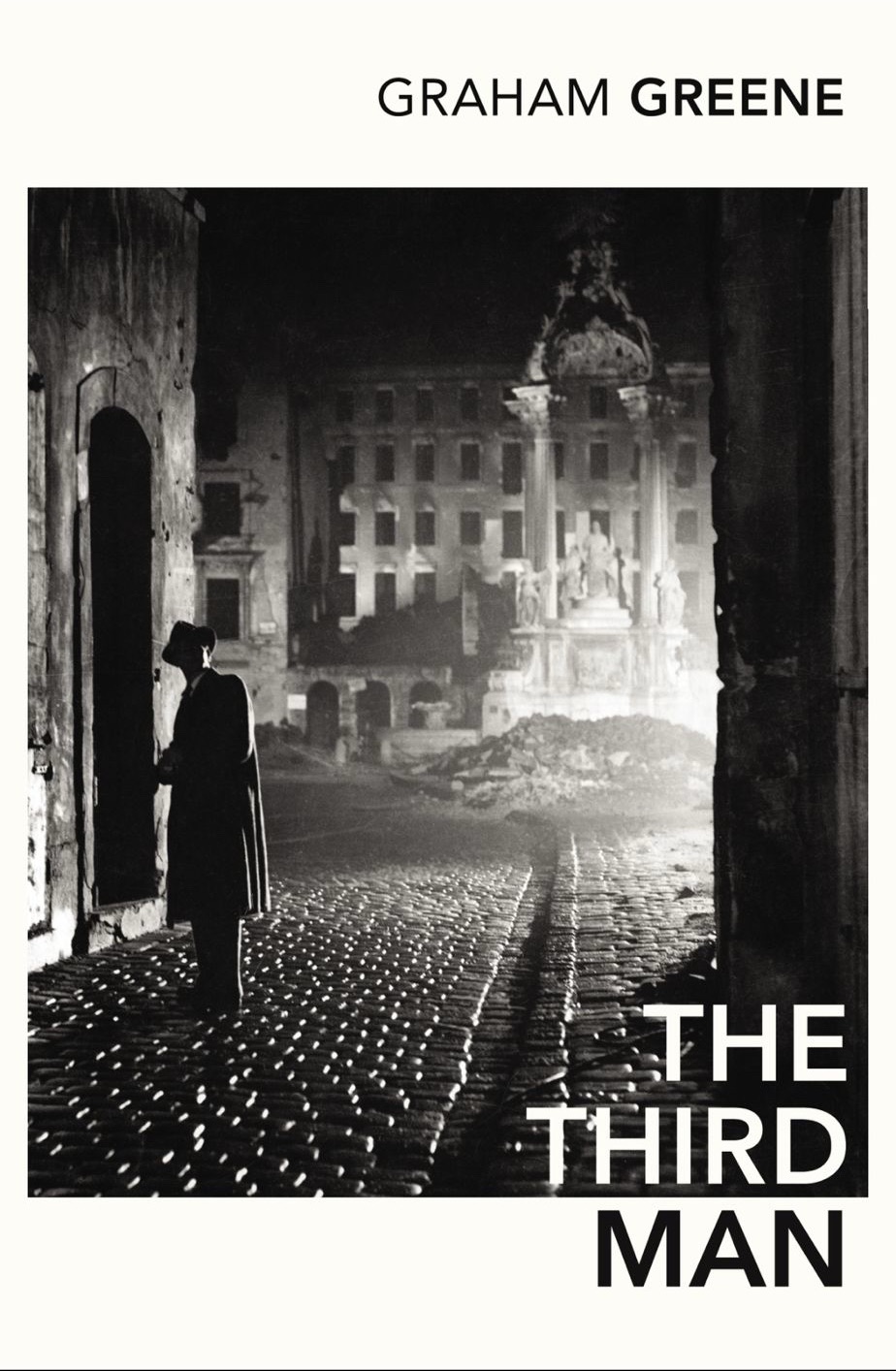
Graham Greene’s most iconic tale, takes place in post-war Vienna, a ‘smashed dreary city’ occupied by the four Allied powers.
Book blurb
The Third Man is Graham Greene’s brilliant recreation of post-war Vienna, a ‘smashed dreary city’ occupied by the four Allied powers. Rollo Martins, a second-rate novelist, arrives penniless to visit his friend and hero, Harry Lime. But Harry has died in suspicious circumstances, and the police are closing in on his associates …
My thoughts
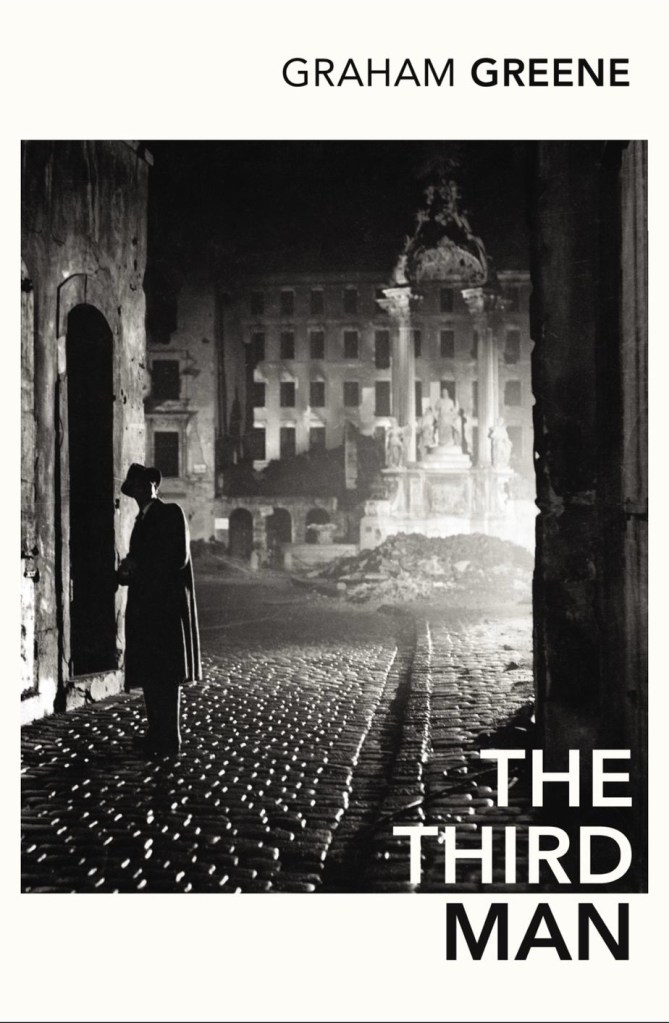
We’ve had the decorator in and the bookshelves were emptied, moved and refilled in no particular order with the bookcases being placed one in front of the other in preparation. Of course, I forgot to pull out my copy of The Third Man by Graham Greene! Luckily, I also have an ebook from Vintage Books (cover pictured) with an introduction by Ian Thomson and so I was able to read that. This particular ebook also includes The Fallen Idol which I won’t be commenting on.
The film in fact, is better than the story because it is in this case the finished state of the story. (Preface)
This is the first time I have read The Third Man but I know the story from the 1949 film directed by Carol Reed. A very atmospheric film that won an Oscar (1951) for Best Cinematography (Robert Kessler) and was nominated but didn’t win in the categories of Best Director and Best Film Editing. The film also won a BAFTA for Best British Film (1950) and the Palm D’or at the Cannes Film Festival (1949). Other awards – National Board of Review: Top Foreign Films (1950); British Film Institute (BFI): Voted the #1 greatest British film of the 20th century and Online Film Critics Society / OFTA: Inducted into the Film Hall of Fame (2006). You can view more details about the production and its history via IMDb. It’s well worth watching.
“To me it is almost impossible to write a film play without first writing a story. Even a film depends on more than plot, on a certain measure of characterization, on mood and atmosphere; and these seem to me almost impossible to capture for the first time in the dull shorthand of a script. One can reproduce an effect caught in another medium, but one cannot make the first act of creation in script form. One must have the sense of more material than one needs to draw on. The Third Man, therefore, though never intended for publication, had to start as a story before those apparently interminable transformations from one treatment to another.
On these treatments Carol Reed and I worked closely together, (Preface)
There are differences between the book and the film. The ending which Carol Reed wanted because it felt was more honest even though it was not a happy ending.
Other changes such as having Alida Valli play Anna making her more physically attractive than she had been written by Greene were purely box office considerations. Yet this also meant that her role in the film was more prominent than the book. Yet a scene which is in the book, albeit one that is being told to Martins, when Anna is kidnapped by the Russians over false papers was eliminated from the film to ensure they were not making an overtly propagandist picture.
Further changes have Lime and Martins as American in the film whilst in the story they were British. Carol and Greene agreed on this to make the film more appealing to the American audience and so better box office. Furthermore, Martins first name was changed from Rollo (in the book) to Holley in the film as apparently Joseph Cotton who played Martins in the film did not like the name Rollo and it was felt that American audiences would be likely to feel Rollo would be considered a ‘sissy’ according to the preface.
It is one of the great moments in screen history. (Ian Thomson, Introduction to The Third Man)
Thomson refers to the scene at the top of the ferris wheel in Park Prater. When the conversation truly confirms to Martins what Lime has become. Whether he should need this confirmation though given the evidence presented to him by the police is perhaps doubtful but Martins and Lime were longtime friends and perhaps Martins needed it.
I’ve watched the film a couple of times and it is indeed cinematically stunning and certainly Vienna stars more so perhaps than in the book but that’s an advantage of watching, seeing rather than conjuring up a place in your mind. I have visited Vienna which allows me to more easily recognise some of the prominent locations. It has been a while since I last watched The Third Man and I felt that the book brought a clarity to the story that I don’t recall from the film but that, as I say, might just be the passage of time.
This was a terrific story that produced an iconic film and I thoroughly enjoyed it.
Book: Purchased (Paperback and eBook)
The 1949 Club
The Classic Year Club reads are hosted by Karen at KaggsysBookishRamblings and Simon at Stuck in a book. To take part just read any book published in the nominated year, this time it’s 1949 and post your review wherever you write or simply add your thoughts in the comment box on Karen or Simon’s blogs then share on Social Media with the #1949Club.
As Simon says: “Pop a link to your review in the comments, or over at Karen’s blog, and if you don’t have anywhere to link to, feel free to put your review in the comments. Happy reading!”
Classic Club
This is also counts as one my fifty Classic Club reads.
Information
Published: Vintage Digital (imprint of Penguin) | 02/10/2010 (Originally published 1949)| ISBN: 9781407086767 | 160 pp
Buy: Penguin | Amazon | Your local bookshop | Your local library
Author
Images: Graham Greene (National Portrait Gallery)
Graham Greene was born in 1904. On coming down from Balliol College, Oxford, he worked for four years as sub-editor on The Times. He established his reputation with his fourth novel, Stamboul Train. In 1935 he made a journey across Liberia, described in Journey Without Maps, and on his return was appointed film critic of the Spectator. In 1926 he was received into the Roman Catholic Church and he visited Mexico in 1938 to report on the religious persecution there. As a result he wrote The Lawless Roads and, later, his famous novel The Power and the Glory. Brighton Rock was published in 1938 and in 1940 he became literary editor of the Spectator. The next year he undertook work for the Foreign Office and was stationed in Sierra Leone from 1941 to 1943. This later produced the novel The Heart of the Matter, set in West Africa. As well as his many novels, Graham Greene wrote several collections of short stories, four travel books, six plays, three books of autobiography – A Sort of Life, Ways of Escape and A World of My Own (published posthumously) – two of biography and four books for children. He also contributed hundreds of essays, and film and book reviews, some of which appear in the collections Reflections and Mornings in the Dark. Many of his novels and short stories have been filmed and The Third Man was written as a film treatment. Graham Greene was a member of the Order of Merit and a Companion of Honour. He died in April 1991.
Also by Graham Greene
Novels
The Man Within | It’s a Battlefield | A Gun for Sale | The Confidential Agent | The Ministry of Fear | The End of the Affair | The Quiet American | A Burnt-out Case | Travels with my Aunt | Dr Fischer of Geneva or The Bomb Party | The Tenth Man | Stamboul Train | England Made Me | Brighton Rock | The Power and the Glory | The Heart of the Matter | Loser Takes All | Our Man in Havana | The Comedians | The Human Factor | Monsignor Quixote | The Honorary Consul | The Captain and the Enemy
Short Stories / Collected Stories
The Last Word and Other Stories | May We Borrow Your Husband? | Twenty-One Stories |
Travel
Journey Without Maps | The Lawless Roads | In Search of a Character | Getting to Know the General
Essays / Collected Essays
Yours etc. | Reflections | Mornings in the Dark
Plays
Collected Plays
Autobiography
A Sort of Life | Ways of Escape | Fragments of an Autobiography | A World of my Own
Biography
Lord Rochester’s Monkey | An Impossible Woman
Children’s Books
The Little Train | The Little Horse-Bus | The Little Steamroller | The Little Fire Engine
The Third Man Book dedication:
‘TO CAROL REED
in admiration and affection and in memory of so many early morning Vienna hours at Maxim’s, the Casanova, the Oriental’


Leave a Reply