
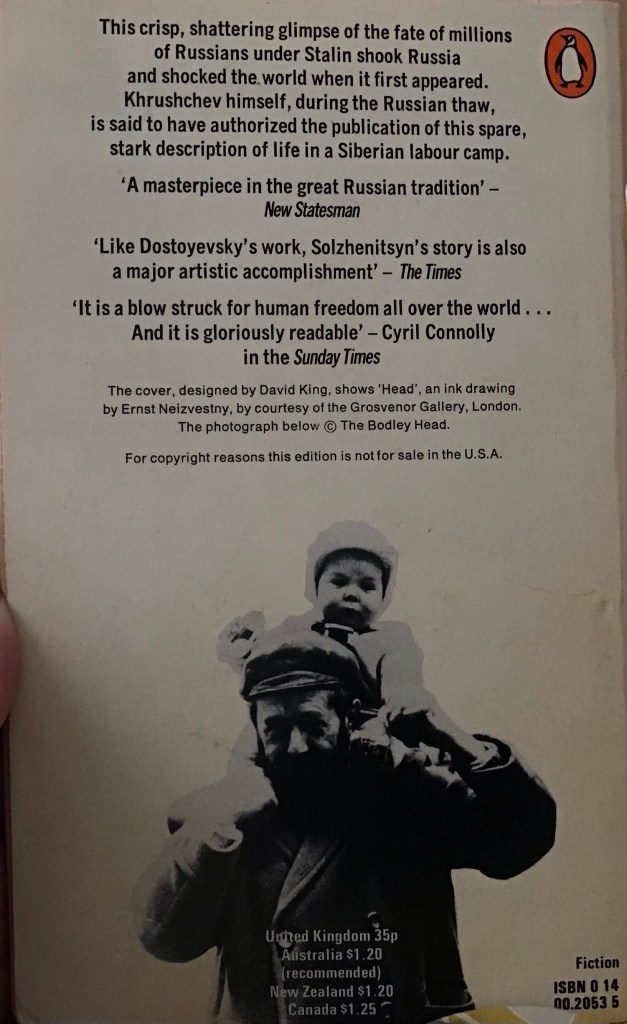
‘A masterpiece in the great Russian tradition’ – New Statesman
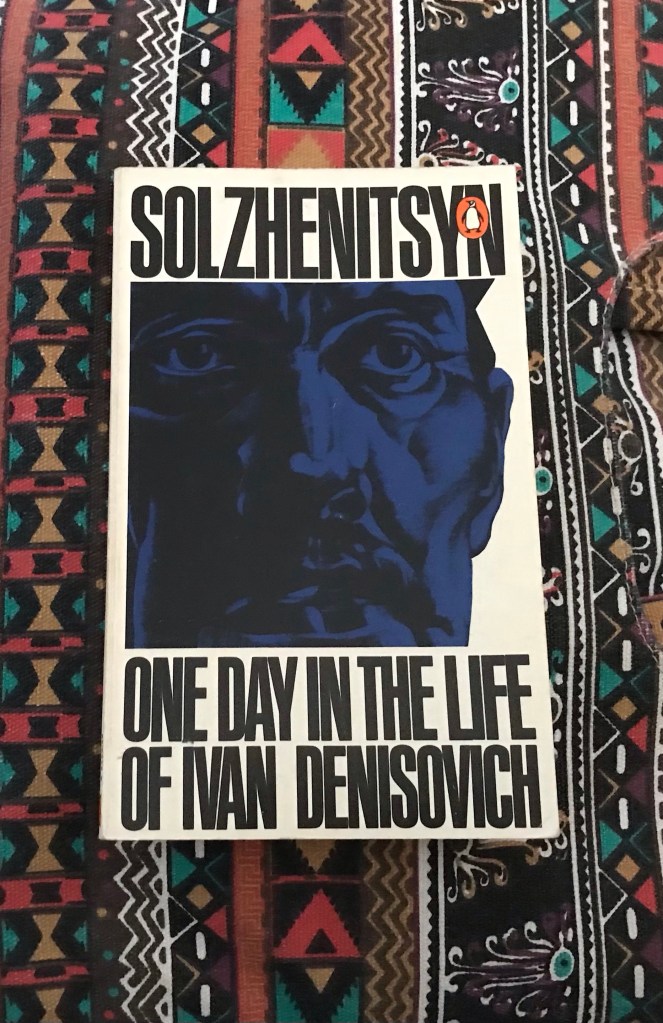
Book blurb
My thoughts
The day starts at five am, earlier if you wake before reveille, there are three ‘meals’ that are barely enough to sustain life. There are many counts of prisoners starting with the count out for the march to work. The last count just before lock in and bed can finish as late as ten.
Ivan Denisovich, generally referred to by his surname Shukhov through the book, is a zek (prisoner) sentenced to ten years he has served eight years. His day starts when he wakes feeling ill. He misses out on getting a sick day so he will be with his team, the 104th, working on whatever work is allocated. It is due to the wily nouse of their foreman that they get a decent job – one that will afford them some shelter from the cold.
Beside the long day, the lack of food (what they do get has little if any nourishment) there is the weather and working in the well below freezing temperatures. You really get how cold it is even having never experienced it through the wonderfully descriptive writing.
Then there are the rules and punishments for breaking them from days in the ‘hole’ (punishment block) to additional terms of imprisonment and when the initial term is ten or twenty five years for the newer intake it is unimaginable how so many carried on.
It is a book so well written that you are gripped with the events of Ivan’s day. Will the team manage to make the ground floor of the building they are working on a haven from the weather?
It is tense. Will Ivan be able to get through the check point returning to the camp when he realises he still has forgotten to hide a short length of metal at the work site and still has it on his person?
There are many wonderful, appalling observations which make this such a stunning story.
It describes the work, the conditions, Ivan’s way of dealing with them and how he manages to get through the day, indeed his sentence, written with an understanding that could only come from someone who had experienced it themselves.
It is a story which in only 144 pages gives you a fascinating insight not only into a prisoner’s day but the psychology of a prisoner in order to survive the brutality of the camps and a tiny consideration of the regime that used such a system to control its citizens. It is a magnificent study of attitude when what you do, how you behave directly relates to whether you are fed, punished and therefore will survive.
This is a stunning novel in which we get the minutiae of the day in great detail whilst giving us a breathtaking insight into the brutal way of life for those who were taken from their homes for the slightest reason and interned in the Soviet labour camps (gulags).
Eminently readable it was a good choice to read for the #1962Club challenge. I may only have read one, short, book but it was one well worth reading.
Thanks to Simon from Stuck in a Book and Karen from Kaggsy’s Bookish Ramblings who hosted The 1962 Club which ran from 16-22 October.
Book: Purchased

Information
Published: First published November 1962 in Novy Mir | This translation first published by Gollancz 1963 | Published in Penguin Books 1963 and reprinted 1968, 1969, 1970 (twice), 1972 (twice). 1973, 1974 (twice), 1975
Buy: Bookshop.org (affiliate link) | AmazonSmileUK | Your local library | Your local bookshop
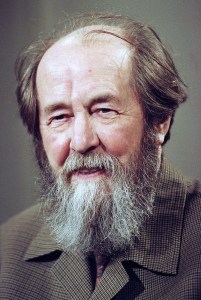
© Jacques Brinon—AP/REX/Shutterstock.com
Author: Aleksandr Solzhenitsyn, (born Dec. 11, 1918, Kislovodsk, Russia—died Aug. 3, 2008, Troitse-Lykovo, near Moscow), Russian novelist and historian. Solzhenitsyn was born into a family of Cossack intellectuals and brought up primarily by his mother (his father was killed in an accident before his birth). He attended the University of Rostov-na-Donu, graduating in mathematics, and took correspondence courses in literature at Moscow State University. He fought in World War II, achieving the rank of captain of artillery. He was arrested in 1945 for criticizing Joseph Stalin. He spent eight years in prisons and labour camps and three more in enforced exile. With One Day in the Life of Ivan Denisovich (1962), based on his labour-camp experiences, he emerged as an eloquent opponent of government repression. He was forced to publish later works abroad, including The First Circle (1968), Cancer Ward (1968), and August 1914 (1971). In 1970 he was awarded the Nobel Prize for Literature. Publication of the first volume of The Gulag Archipelago (1973) resulted in his being charged with treason. Expelled from the Soviet Union in 1974, he moved to the U.S. In the late 1980s glasnost brought renewed access to his work in Russia. In 1994 Solzhenitsyn ended his exile and returned to Russia. From 1998 to 2003 he published installments of his autobiography, “The Little Grain Managed to Land Between Two Millstones,” and in 2007 he was awarded Russia’s prestigious State Prize.





One response to “#1962Club – One Day in the Life of Ivan Denisovich by Aleksandr Solzhenitsyn (Translated by Ralph Parker)”
[…] found this book on my shelves which was first published in 1962: One Day in the Life of Ivan Denisovich by Alexander Solzhenitsyn (translated by Ralph Parker) and published in 1963 by Penguin […]
LikeLike