
The darker the secret, the harder to bury it. Compelling reading – Lilja Sigurðardóttir
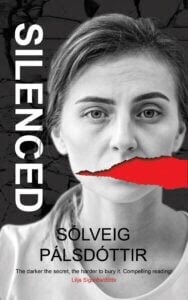
‘A sinister story of fear and isolation told with imaginative flair. Mesmerising.’ – Michael Ridpath
Book blurb
As a police team is called in to investigate a woman’s suicide at the Hólmsheiði prison outside Reykjavík, to detective Guðgeir Fransson it looks like a tragic but straightforward case.
It’s only afterwards that the pieces begin to fall into place and he takes a deeper interest in Kristín Kjarr’s troubled background, and why she had found herself in prison.
His search leads him to a series of brutal crimes committed twenty years before and the unexplained disappearance of the prime suspect, whose wealthy family closed ranks as every effort was made to keep skeletons securely hidden in closets – while the Reykjavík police struggle to deal with a spate of fresh attacks that bear all the hallmarks of a copycat.
Silenced won the 2020 Drop of Blood Award for the best Icelandic crime novel of the year, and was Iceland’s nomination for the Glass Key Award for the best Nordic crime novel of 2021.

My thoughts
Kristin Kjarr is found dead in her cell at Hólmsheiði prison. She had been imprisoned for driving her car into a house almost killing a young skateboarder and the elderly woman who was at home sick. It looks cut and dried – she has committed suicide. However, to Detective Guðgeir Fransson he feels that there is something not right. Guðgeir gets the agreement of his boss Særós to look into it.
The book is character driven and gives a well rounded perspective of the main characters in the story. Giving, for example, Guðgeir a life outside of work. It is whilst he is working on the floor of the new home he and his wife will be moving into that he meets Andrea, a neighbour. Andrea finding that Guðgeir is a policeman talks to him about her brother who went missing years before. He agrees to take a look at the case.
Jóhannes, Andrea’s brother, vanished on 17 June 2000 camping at the lakeside of Thrastarlunder. He was with his brother, Daði, and a friend. After being in Hveragerði and getting caught up in an earthquake when they returned to the campsite they couldn’t find him. In the end whilst no body was found it was assumed that he had died.
Elsa Guðrún is returning to work after a break and joins Guðgeir in the investigations. As they look into the older case they find connections with Kristin Kjarr. She had been Jóhannes girlfriend. She crashed her car into the home of Jóhannes parents. She had been drawing pictures of someone who looked like Daði.
There are lots of questions from Guðgeir. Why would you commit suicide when you only had a few days left to serve? What do the connections between the two cases mean? Why draw so many pictures of someone? Even more questions arrive as they continue to gather information. Why did Daði say he didn’t know Kristin? Why would Kristin crash into the Eythórson’s house? Kristin killed herself but why?
The more Guðgeir and Elsa investigate the more they find that there is a connection between Jóhannes case and Kirstin death. They find out that Jóhannes had raped Kirstin and that there were other possible victims. The family are not happy to have these facts brought out. Then there is an attack on a woman in her own home, is there a copycat rapist? Then history repeats itself in a devastating manner and very close to home! Can they find the perpetrator? Will justice be done?
The ending isn’t neatly packaged but I feel that the author wanted to do two things. Firstly, to show that in cases of rape, sexual assault or other sexual offences there is often no outcome, no justice because the perpetrator is not found or not convicted for some reason. Secondly, to allow personal closure to one of the characters. If you watch the video below the author does say that the ending had to be for all victims and so was more of a symbolic ending.
So, the ending reflects that justice has its hands tied, has been silenced. As it happens in real life it is good now and then to show it happening in the fictional world. And for one character the conclusion may not have brought justice – yet – but it did bring a kind of closure and an ability to move forward.
Sólveig Pálsdóttir is obviously very passionate about this kind of crime, why they are committed, why they are not always brought to justice and how the victims are affected.
This is a well written story about a heartbreaking crime which affected several characters in different ways. It is sensitively written and is in no way graphic. It is an important story to have been written in order to keep such crimes visible, give a voice to those who have never received any kind of justice and simply say we must be better at supporting victims of sexual assault, at finding the perpetrators and at bringing them to justice.
I look forward to reading more of this author’s work.
It is a must to acknowledge the translator without whom I and many others would not be able to read and enjoy foreign language books and to the publishers who bring these wonderful stories into our lives. Thanks to Quentin Bates and Corylus Books.
Book: Purchased
The Virtual Crime Book Club
The Virtual Crime Book Club is hosted by Rebecca Bradley, author of the D I Hannah Robbins and D I Claudia Nunn series as well as standalone novels.

July’s Book Club
Silenced by Sólveig Pálsdóttir, translated by Quentin Bates and published by Corylus Books was chosen as the book club’s read for July. Below is a link to the YouTube video of the book club’s discussion.
The discussion was preceded by very engaging chats with the author Sólveig Pálsdóttir and the translator Quentin Bates.
⚠️ Warning ⚠️
If you watch the meeting below do be aware it contain spoilers so, if you’re planning to read the book, perhaps better not to watch it until you’ve done so.
Watch July’s book club episode Silenced by Sólveig Pálsdóttir
⚠️ Warning ⚠️
Join
Translator
Quentin Bates is a translator and author in his own right you can find more information about him, his translations and his books on his website.
Information
Published: Corylus Books Ltd | 15 April 2021 | 269 pages
Buy: AmazonSmileUK | Bookshop.org (affiliate link) | Hive | Kobo |your local library | your local bookshop
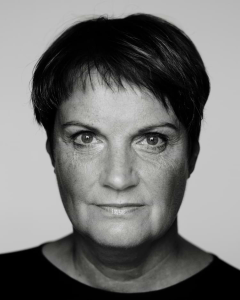
Author: Sólveig Pálsdóttir has a diverse background. She’s a trained actor and has performed in theatre, television and radio. She holds a bachelor’s degree in literature from the University of Iceland along with a degree in teaching. Sólveig taught Icelandic literature and linguistics, drama and public speaking for many years and has produced a number of radio programmes and managed cultural events.
Her first novel Leikarinn (The Actor) was published in 2012 to rave reviews and weeks at the top of best-sellers lists. It is now being developed as a motion picture. The second novel, Hinir réttlátu (The Righteous Ones), was published the following year, and also became a best-seller. Both novels have been published in Germany by Aufbau as Eiskaltes Gift and Tote Wale. Her third novel, Flekklaus (Pure), was published in March 2015. Her fourth book, Refurinn (The Fox) also made its way to Iceland’s best-seller list.
All her novels have been shortlisted for the Icelandic Crime Fiction Awards and have been praised for their narrative, attention to detail and sympathetic characters.
Fjötrar (Silenced) was published in 2019 and won the Icelandic Drop of Blood award for the year’s best crime novel, and was shortlisted for the Nordic Glass Key Award.
Sólveig lives in Reykjavík and is married with three children and four grandchildren.
@solveigpals |on Facebook
Books
- 2020 Klettaborgin
- 2019 Shackles/Silenced
- 2017 The Fox
- 2015 Immaculate/Pure
- 2013 The righteous
- 2012 The Actor
From Corylus Books Ltd.: The Fox | Silenced | Harm
 Janet - LoveBooks, ReadBooks: A readers musings, thoughts and reviews
4 responses to “Silenced by Sólveig Pálsdóttir, Translated by Quentin Bates @corylusbooks #20BOOKSOFSUMMER23 #AVIRTUALCRIMEBOOKCLUB”
[…] Silenced by Sólveig Pálsdóttir […]
LikeLike
[…] Silenced by Sólveig Pálsdóttir […]
LikeLike
What a great review – you really got all the nuances of what the author was trying to do. Also, Iceland is often perceived as a society where there isn’t too much class or wealth difference, and I think this book shows that this is a bit of a myth (probably just like everywhere else).
LikeLiked by 1 person
Thank you for your kind comment. So pleased you think so. Yes, as you say class/wealth difference is another point which I agree is probably no different to anywhere else, sadly.
LikeLike